

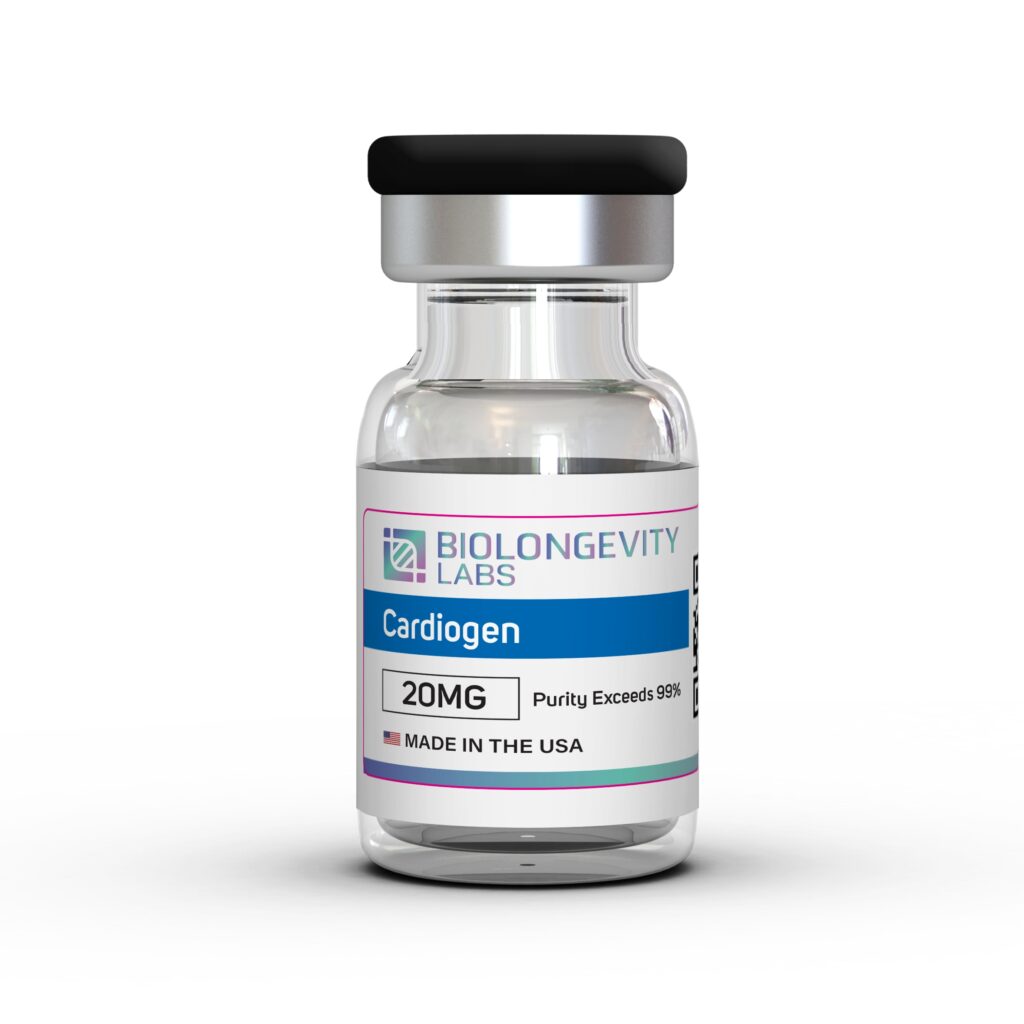


Cardiogen (20mg) For Sale
Cardiogen (AEDR) is a synthetic tetrapeptide with the sequence H-Ala-Glu-Asp-Arg-OH. It functions as a bioregulator peptide, primarily targeting fibroblasts and cardiomyocytes to modulate tissue repair and cardiovascular function.
Cardiogen Peptide Description
Cardiogen is a synthetic tetrapeptide (H-Ala-Glu-Asp-Arg-OH) that has been studied for its dual role in cardiovascular repair and cellular regulation. Cardiogen targets fibroblasts—key cells in tissue repair—and cardiomyocytes to promote heart muscle regeneration while inhibiting scar tissue formation. Its molecular structure underpins interactions with cellular signaling pathways linked to oxidative stress and inflammation.
Peptide Information
| Property | Value |
|---|---|
| Peptide Sequence | Ala-Glu-Asp-Arg |
| Molecular Formula | C18H31N7O9 |
| Molecular Weight | 489.5 g/mol |
| PubChem CID | 11583989 |
| Synonyms | SCHEMBL3194515 |
Product Usage:
This PRODUCT IS INTENDED AS A RESEARCH CHEMICAL ONLY. This designation allows the use of research chemicals strictly for in vitro testing and laboratory experimentation only. All product information available on this website is for educational purposes only. This product should only be handled by licensed, qualified professionals. This product is not a drug, food, or cosmetic and may not be misbranded, misused or mislabeled as a drug.
Cardiogen Research
Research suggests Cardiogen stimulates cardiac cell proliferation, inhibits fibroblast-driven scar formation, and reduces apoptosis by suppressing p53 protein expression. Investigated for applications in heart disease (e.g., heart failure, myocardial infarction) and tissue regeneration, it may also influence cancer pathways by promoting tumor cell apoptosis in sarcoma models.
Cardiogen’s Dual Mechanism in Cardiac Repair
An experimental study investigated cardiac regeneration mechanisms using Cardiogen, a synthetic tetrapeptide, in comparative analyses with 20 naturally occurring amino acids. In heart tissue cultures from rats aged 3 months (young) and 24 months (old), Cardiogen uniquely activated cardiomyocyte proliferation while suppressing apoptosis markers like p53 protein—effects not observed with individual amino acids. This dual action suggests Cardiogen operates through distinct pathways compared to standard nutrient-based approaches, combining growth stimulation with cell survival mechanisms.
Notably, age-related disparities emerged in responses to conventional amino acids: seven amino acids showed proliferative effects in young rats versus only two in older specimens. Cardiogen’s performance remained robust across both age groups, maintaining its efficacy even in aged tissue where natural regenerative capacity diminishes. These findings position the tetrapeptide as a promising candidate for addressing age-related cardiac dysfunction, particularly in elderly populations where current regenerative therapies often underperform.1
Cardiogen Modifies Tumor Growth in M-1 Sarcoma
Cardiogen peptide exhibits a tumor-modifying effect on M-1 sarcoma in senescent rats by enhancing apoptosis and inducing hemorrhagic necrosis, leading to dose-dependent inhibition of tumor growth. Cardiogen peptide injections resulted in a higher level of apoptosis in tumor cells compared to the control group, indicating its effectiveness in promoting cell death within the tumor.
The growth of M-1 sarcoma was inhibited in a dose-dependent manner following cardiogen administration. The inhibition of tumor growth was not due to a direct cytostatic effect on the tumor cells. Instead, cardiogen appears to work through a specific mechanism involving the tumor’s vascular network, leading to hemorrhagic necrosis and increased apoptosis.2
Cardiogen and Prostate Fibroblast Function
Short peptides such as T-32, T-38, and cardiogen have been shown to significantly enhance the expression of key signaling factors like CXCL12, WEDC1, and ghrelin in aging prostate fibroblasts. These factors are crucial for fibroblast differentiation and their expression decreases in senescent cultures.
Findings suggest these peptides could reverse age-related declines in prostate fibroblast function, highlighting their potential for developing therapies to counteract prostate aging.3
Certificate of Analysis (COA) for Every Batch
A Certificate of Analysis (COA) is a document that verifies a compound’s identity, purity, and batch quality through independent laboratory testing. Every compound from BioLongevity Labs ships with a COA tied to its specific batch, so researchers can confirm exactly what they received before it enters a protocol.
Each COA reports results from third-party laboratory analysis, including:
- High-performance liquid chromatography (HPLC) for purity, typically confirmed at 99% or higher
- Liquid chromatography mass spectrometry (LC-MS) for molecular identity and mass confirmation
- Sterility and endotoxin screening where applicable
- Chemical contaminant and residual solvent checks
COAs are sourced from independent certified labs rather than in-house testing alone, giving researchers a verifiable record of molecular integrity for each batch. All compounds are supplied for research use only.
Reviews
There are no reviews yet.